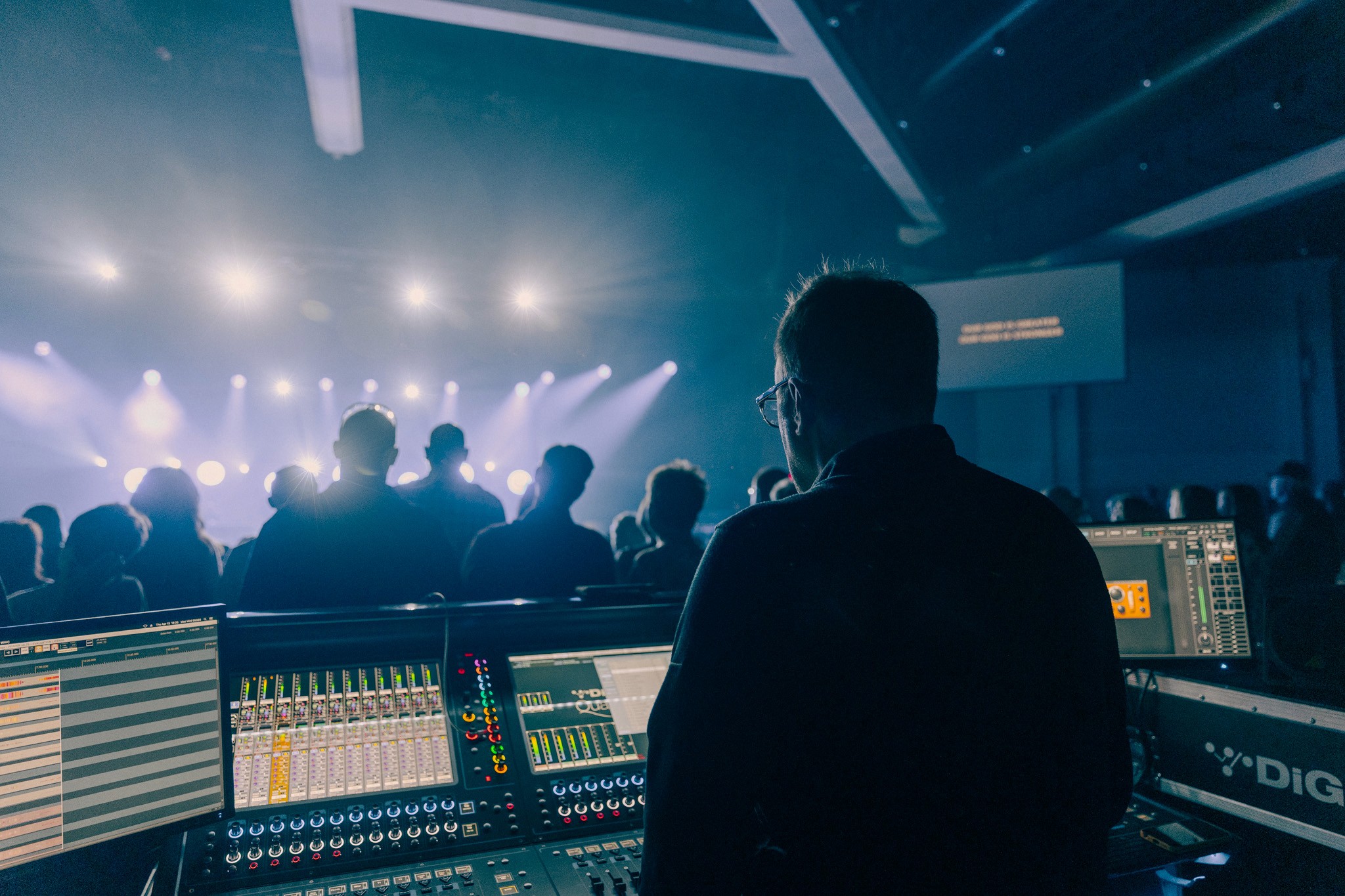

How to Create a Worship Environment That Actually Engages (Lessons From the Gettysburg Cyclorama)
MxU Team
on
Pro Tips

I was recently on a school trip with my son to the East Coast — an incredible tour of the early settlements, our nation's capital, and the history of how this country began. But the most creative thing I saw the entire trip wasn't from this century. It was from 1883.
If you ever get the chance to visit Gettysburg, Pennsylvania, the visitor center holds something called The Gettysburg Cyclorama. It's a 42-foot-high, 377-foot-circumference painting of the Battle of Gettysburg. Created by French artist Paul Philippoteaux back in 1883, the painting wraps all the way around you, putting you in the middle of the action. Add in life-sized foreground replicas, layered lighting, haze, and sound, and the experience completely engulfs you.
When you first walk in, it takes a second to find your bearings. Then a voice comes over the system, gives you a few visual markers, and within seconds you're surrounded by the battle. The detail is staggering. One veteran who actually fought at Gettysburg reportedly stood in front of the painting and said to a friend: "You see that puff of smoke? Just wait a moment until that clears away, and I'll show you just where I stood."
That's a 140-year-old experience design lesson hitting harder than most modern churches manage on a Sunday morning.
And it made me realize something. Long before edge blending, environmental projection, and immersive lighting rigs existed, artists already understood that environment shapes experience. They knew how to make people feel like they were inside something bigger than themselves. The tools have changed. The principle hasn't.
This is what I've learned about creating a worship environment that actually engages — and what most of us are still missing.
Why the Worship Environment Matters More Than Most Churches Realize
There's a temptation in church world to treat the worship environment as decoration. Stage looks fine. Lights are on. Lyrics are up. We're good.
But environment isn't decoration. It's the frame around the experience. And the frame either invites people in or quietly pushes them out.
A congregation walks in carrying everything they've been carrying all week — the argument with their spouse on the way over, the email they shouldn't have read, the stress about Monday. The worship environment is what helps them set that down. The lighting that softens the room. The transitions that don't yank them out of a moment. The visual cues that say you're somewhere different now. The absence of clutter that would otherwise pull their eyes to the wrong place.
When a church gets the environment right, people don't notice it. They just feel it. When a church gets it wrong, people don't always know why they feel disengaged — they just do.
The Cyclorama works because every single element conspires to put you somewhere else. Your worship environment is doing the same thing every weekend, whether you've planned it or not. The only question is whether it's working for you or against you.
The Last 10% — Why Detail Solidifies the Worship Experience
Disney World has a small detail most people miss: peanuts embedded in the cement around the Dumbo ride. Why? Because at some level, the imagineers know that the last 10% is what separates an okay experience from a memorable one. Most guests will never consciously notice the peanuts. But the people who do will tell that story for years.
The Cyclorama is full of those moments. Tiny soldiers in the distance. A bullet hole in a fence post. A field hospital glimpsed at the edge of the scene. The painting could have worked without them. It works better because of them.
Now think about your worship service. People close their eyes. They focus their attention on God. They engage. And then the song ends, they open their eyes, and they see…
A pile of cables in the corner. An open laptop on the platform. Three different generations of music stands. A volunteer's empty coffee cup on the side stage.
That's the last 10%. And nobody set out to ruin the moment — somebody just didn't take the extra hour. But that hour is the difference between an environment that holds the experience and an environment that quietly punctures it.
What in your worship environment is just one decision, one cleanup, or one cable away from being right? That's where the engagement is hiding.
Design Is Not the Same as Decoration
Here's the part that gets missed.
Philippoteaux didn't just sit down and paint. He spent 18 months with five assistants, mapping every section of the canvas, planning sightlines, calculating what each viewpoint would reveal. The Cyclorama wasn't decorated — it was designed. Every choice was intentional.
Compare that to how most weekend services come together. We plan the big things — the songs, the message, the call to action. And then the small things "kind of come together" on Saturday night. The transition between the second song and the announcement video? Figured out at 9:45 AM. The lighting change for the closing prayer? Improvised. The graphic that hits during the bridge? Loaded fifteen minutes before doors open.
Designing a worship environment means thinking through the journey the way Philippoteaux did. Not just what happens, but how it lands. Where the eye goes. Where the energy builds. Where it should land soft. Where the silence should sit. What the platform should look like during the message that's different from what it looked like during worship.
The shift from decoration to design is the shift from "we'll figure it out" to "this was thought through." Your congregation may never articulate the difference. But they'll feel it every week.
This is one of the gaps that MxU's training library is built around — helping worship and tech leaders develop the eye for design, not just the skill for execution. Because skills without design instinct still produce a service that feels accidental.
5 Areas Where Worship Environment Design Breaks Down
These are the places I see worship environments fall apart most often. Each one is fixable. Most of them cost nothing but attention.
1. Stage Clutter
The most underrated environmental killer. Extra cables, unused stands, gear cases that didn't get put away, water bottles, gaff tape rolls, set pieces from last weekend that never came down. Every one of those items is competing for the congregation's eye. Run a 30-second "clutter sweep" right before doors open and you'll instantly upgrade the visual environment.
2. Transitions
The space between elements is where most churches lose people. The awkward five seconds while the band gets in position. The graphic that disappears too early. The lighting that goes from full worship wash to fluorescent house lights in a blink. Transitions should be designed, not survived. Map them out the same way you'd map out a song.
3. Lighting Cues
Lighting is the fastest way to shift the emotional temperature of a room — and the most often ignored. If your lighting state during the worship set looks identical to your lighting state during the announcements, you're missing one of the most powerful tools you already own. Even simple intensity changes between elements communicate volumes.
4. Environmental Projection
This is where the Cyclorama lesson gets literal. Modern environmental projection — projecting subtle imagery, textures, or color washes onto the side walls and surfaces of the room — extends the worship environment beyond the platform. Done well, it's the closest thing we have to immersing a congregation the way Philippoteaux immersed visitors. Done badly, it's a distraction. Like everything else, it lives or dies by the design behind it.
5. The Post-Service Moment
What happens in your room during the 90 seconds after the service ends? In most churches, the lights snap to bright, the music cuts off, and the spell breaks instantly. That moment is part of the environment too. A gradual lighting shift, a soft instrumental track, a slower pace — these signal that what just happened mattered. People shouldn't feel like they got ejected from worship the second the pastor said amen.
A Simple Framework for Auditing Your Worship Environment This Week
Want to see what your congregation actually experiences? Try this.
Walk into your auditorium thirty minutes before service starts and sit in three different seats — front, middle, back. At each seat, ask yourself:
What am I drawn to look at? (That's where the eye is going. Is it where you want it to go?)
What feels unfinished or out of place? (That's the last 10%.)
What would distract me from worship if I were a first-time guest? (That's the gap between decoration and design.)
Then run the same audit during the service from a back-row seat. Pay attention to the moments between the elements. Watch the transitions. Notice when the energy drops or jumps without intention.
You'll find five things in 20 minutes. None of them will require a budget. All of them will improve the environment immediately.
The Bottom Line
Philippoteaux took 18 months to create something that would put visitors inside a single moment in history. We get one weekend at a time to put a congregation inside the presence of God. The stakes are not the same — they're far higher.
If a 1883 painting can teach us anything, it's that environment is never accidental for the people who care about it. Detail solidifies the experience. Design separates the memorable from the forgettable. And both of them — together — are how a worship environment stops being something you set up and starts being something that actually carries the moment.
Your congregation is showing up next weekend. The environment they walk into is already being designed, whether you've designed it intentionally or not.
Make it intentional.
Ready to build a worship environment your congregation actually feels?
MxU equips worship leaders, tech directors, and church creatives with the training, tools, and community to grow your craft and elevate your weekend experience. Whether you're refining the details or rethinking the design from the ground up — we'll meet you where you are.